Monday, January 24, 2011

Field Trip!


(Sorry I hadn't realized this hadn't posted!)
Society's complex structure, when dissected, can be broken down into key elements of architecture: groves, stacks, circles, and various repetition. On a stroll through campus I found that Greensboro is no exception to the rule. The question is, how do ritual and environment react to each other?

Groves common in nature include forests, sunflower patches, and humans themselves. We see them in skyscrapers and clocks towers, reaching into the heavens. In Greensboro I observed columns and light posts that imitated these vertical reaches. I connected the form of the structures with society's constant striving to go higher on the social ladder, to be at the top. Maybe this continuity in architectural form reflects this desire.

These columns represent groves


Stacks are another familiar form in design. Originally they   could have been a representation of stacks of supplies or the stack of layers of land to form mountains. They remind me of culture's organization, abundance, and foundations. They seem to visualize a hierarchy that is oh so similar to cultures throughout history. In Greensboro's campus there are stacks of bricks, stacks of concrete stairs, and stacks of floor levels and windows on every turn. The fountain displays very clear levels that lead to the fountain itself, a meeting place, a spot of interest, a ritual in itself.


Circles are a symbol of strength, with no end and no beginning. They can address a focal point or be a symbol. Circles are prevalent in nature; the sun, the planets, tree trunks, ripples; all are translated in the use of circles. We refer to existence as the "circle of life", rely on the water cycle, are familiar with the never ending orbit of the earth, use circles to refer to time, and use them in nearly every form of transportation. Circles are a primary shape in our world, and are integrated heavily in for design. In Greensboro I saw them as manholes, as fountains, as a structure for bridges, in detail and in design.


These shape motifs and the order, control and balance of repetition are hard to miss in the world around us. But why are they so common? Are the reasons scientific or aesthetic? Geometrical or traditional? For strength or routine? Why can these particular formations be traced through history? I believe that the environment we created is an echo of the rituals that we live by. The shapes and structures are those we take from the environment that are relevant to our culture.

Tuesday, January 18, 2011

Nabta Playa, Egypt


Nabta Playa: 
Stone Circle


Location of the Stone circle
Nabta Playa, Egypt was an important ceremonial location for prehistoric people to record astronomical events. It is situated west of Abu Simbel and is a basin shape that was often filled with water. Nabta Playa is also the site of the only megalithic circle in Egypt. The stone circle is constructed of five lines of “flat, tomb-like stone structures” and stands west of the Nile River. This circle originates before the more famous Stonehenge and lines up with the Tropic of Cancer. This causes the fixture to cast no shadow for several minutes during the summer solstice. This shows the pursuit of knowledge and curiosity that Egyptians had during this time. Egypt is known for their early use of language and writing and advanced religious beliefs. This stone structure captures the aptitude the Egyptians had for the world around them.
There is a connection (assumed to be purposeful) between the Tropic of Cancer and this particular  stone circle.

Heading for Spring

This new semester marks a fresh start. I'm trying to take what I learned from last semester and apply it without the things that held me back last semester. I tend to stick with one idea and force it to succeed no matter what. The outbursts in the header I created represent the beauty of expanding from that seed of an idea. I want to be open to changing and accepting new concepts and let myself fade into the background of design, and let it take over. I'm excited for the new creations of a new semester!

Wednesday, December 8, 2010

They're so Above Me...

Today I attended an upperclassmen final critique. Their project was to design a new library. They spent a good deal of time researching the history of the library and surveying the community that uses it. I was amazed by the detail of the project and how they meticulously perfected each aspect of the structure. The class worked in groups on each area of the library, including a child care area, the stacks, the multimedia center, the check out area, and the atrium. The library also featured an art work piece that was intended to unite all sections of the structure. Glass panels similar to the Eco-cloud are blue from one direction, green from another, and converge in the middle. I admired their efforts for sustainability especially. They planned to have a green roof, use rain (grey) water for toilets, and used bricks from the old structure in the floor of the new building. There were several more environmentally friendly strategies they planned that I can't remember. I thought that for their first time designing a real building it was very impressive. I can't believe that will be us in just a few years.

Tuesday, December 7, 2010

Design Visualization 101 in Retrospect

The first semester is over, and I've learned a lot. Never before this semester did I think about the weight and quality of my lines, but I've learned to improve my pencil skills. In complete honesty, this was a very difficult class for me, but I feel like I've improved a lot. I'm so ready for digital drafting :)
Here's one of my recent drawings. I'm sorry I couldn't figure out how to touch it up :(

Figuring it Out

We've been doing some quick figure sketches in class, here are a few!

Monday, December 6, 2010

Playing with Light


This is my most successful sketch model for our luminare assignment. The use of glass and wood continued to evolve towards my final project, but hemp aspect didn't make it.


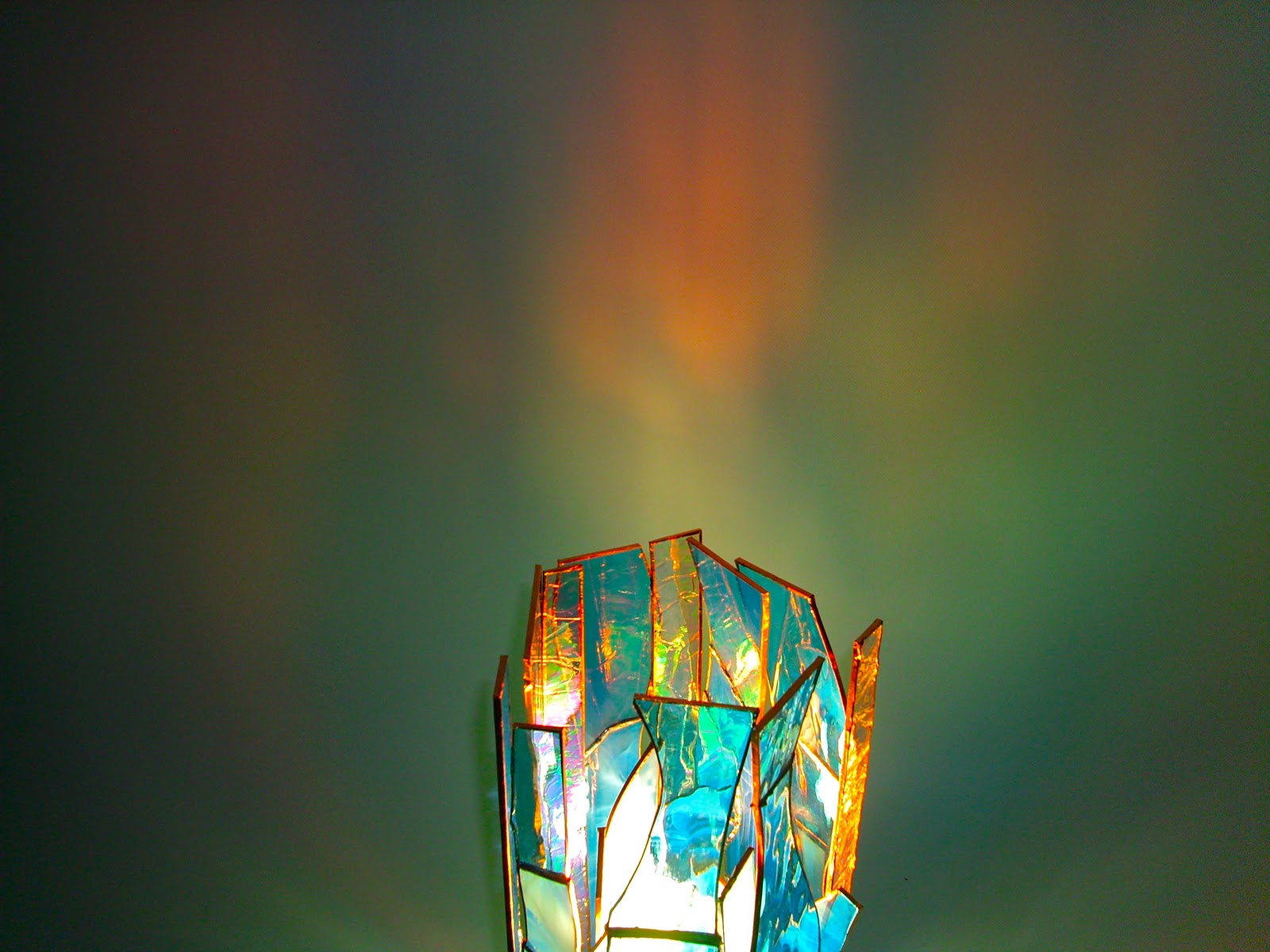
This is the luminare I made. My inspiration came from a photograph of sunlight reflected off water. I wanted to capture certain aspects of the light effect like the blue tones enhanced by the sunlight, the inconsistency of the waves, and the bright sunshine that sparkled off the water. To do this I spent long hours on the internet to teach myself how to break the glass at curves, foil the glass, and solder it into a structure. The curved glass is an interpretation of the waves, the brighter light that comes through the cracks imitates the light reflected. The project is constructed from assorted tainted and textured glass, fitted into a grooved wooden base. I used a daylight bulb for a harsh, sunny effect.  I'm in love with the fairy-like light effect that plays on the wall, so I would say I've succeeded. Take a look and tell me what you think!